
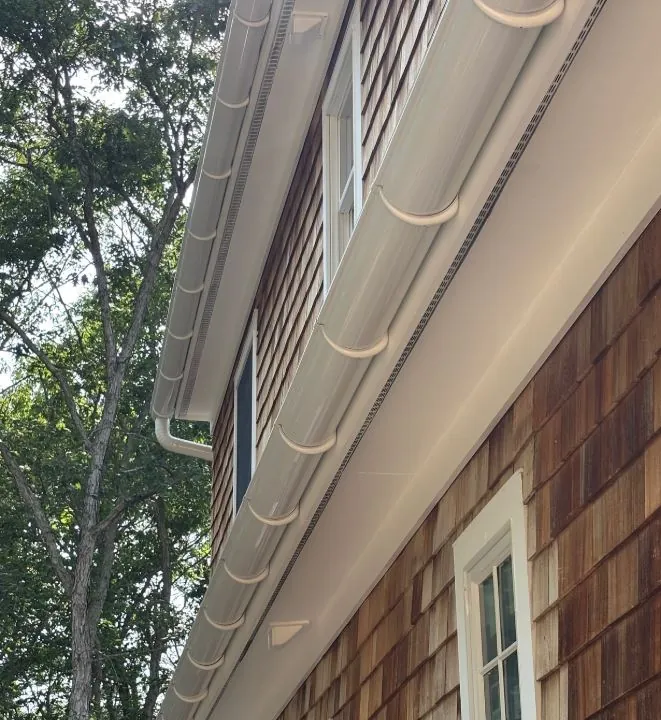
A seamless gutter starts as a flat coil of aluminum on the back of a truck. It is fed through a portable roll-forming machine that shapes the metal into a continuous K-style or half-round profile, cut to the inch for the fascia run. There are no seams every ten or twenty feet the way there are with store-bought sticks. The only breaks in the gutter are at inside and outside corners and where a downspout outlet is punched in.
In Jacksonville, a typical afternoon storm can bring a short, heavy downpour. A seamed gutter has a gasketed joint at every splice, and those gaskets dry out, shrink, and eventually leak. A seamless gutter removes that weak point for most of the run. Installations commonly use .027 or .032 aluminum depending on the span and tree load, and each section is hung with hidden hangers screwed into the fascia.
Seamless Gutter Profiles and Material Choices
Seamless gutters are formed in two profiles and a range of sizes to match the roof edge and the amount of water the system needs to carry.
| Option | Best for | Notes |
|---|---|---|
| K-style 5-inch | Most residential homes with standard roof areas and asphalt shingles | The flat back and decorative front lip mimic crown molding. Holds more water per foot than a same-width half-round. It is typically paired with 2x3 downspouts on most single-story homes. |
| K-style 6-inch | Steep roofs, large roof planes, two-story homes, and commercial buildings | Carries noticeably more water than 5-inch. Stepping up to 3x4 downspouts and adding extra outlets on long runs helps handle the volume during heavy downpours. |
| Half-round 5-inch and 6-inch | Older Florida bungalows, historic homes, and certain beach cottages | The open, rounded shape drains well and is less likely to hold standing water. Brackets mount differently than K-style hangers, so fascia condition should be checked carefully before quoting. |
| .027 vs .032 aluminum thickness | Choosing the right gauge for the site | .027 is standard for most residential work. .032 is recommended for longer spans, homes under heavy tree canopy, or properties near the coast where wind loads are higher and salt air accelerates metal fatigue. |
Why Fewer Seams Matter in Jacksonville Rain
Every seam in a gutter is a potential leak point. Sectional gutters from a home center come in 10- or 20-foot lengths. A 40-foot eave needs at least one splice, often two. Each splice relies on a rubber or butyl gasket and a snap-in connector. Jacksonville summers bake those gaskets. After a few seasons they harden, crack, and start dripping, usually right over a window or a walkway. A seamless gutter eliminates the mid-run splice entirely. The only joints are at corners and outlets, and those are sealed with heavy-duty gutter sealant applied by hand.
During hurricane season, wind-driven rain hits gutters from the side as well as from the roof. A seamed joint that has loosened over time can separate under wind load, letting water pour down the fascia. Seamless gutters hold their shape as one continuous piece. Tighter hanger spacing helps keep the gutter from pulling away when it is full of water and debris.
For homes with live oaks or pines nearby, the fewer places debris can catch, the better. Pine needles and oak leaves snag on splice connectors and hold moisture against the metal. A smooth, continuous run has fewer snag points, so water and small debris move toward the downspout more easily. It does not replace the need for regular cleaning, but it reduces the number of spots where clogs start.
How a Seamless Gutter Installation Runs
Measure and inspect
The roofline is walked with a laser measure and fascia boards are checked for rot or soft spots. Roof pitch, overhang depth, and downspout discharge points are noted.
Fabricate on site
The aluminum coil feeds into the roll former mounted on the truck. The machine shapes the profile to the exact foot and inch, and each run is cut as a single piece.
Pitch and hang
A slight pitch is set toward each outlet, about a quarter inch per 10 feet, so water moves without pooling. Hidden hangers are screwed into the fascia.
Corners, end caps, outlets
Mitered corners are cut and sealed. End caps are crimped and sealed. Downspout outlets are punched and the downspout sections are assembled with elbows and brackets.
Test with water
Water is run through the system from a hose or a bucket at the high end and the flow is watched. Every seam, corner, and outlet is checked for drips before the job is complete.
Seamless Gutters for Jacksonville’s Rain and Humidity
Jacksonville gets most of its rain in short, intense bursts, afternoon thunderstorms from June through September that can overwhelm an undersized or poorly sealed gutter in minutes. A seamless 6-inch K-style gutter with 3x4 downspouts moves that water off the roof and away from the slab much faster than a standard 5-inch sectional system. The total roof area draining to each downspout should be considered to size the gutter and outlets accordingly.
Homes near the Atlantic, Atlantic Beach, Neptune Beach, Jacksonville Beach, deal with salt spray and salt-laden air that corrodes exposed fasteners and unprotected steel brackets. Aluminum for the gutter and the hangers resists the salt better than galvanized steel. Inland neighborhoods like Mandarin or the Westside see less salt but still deal with high humidity and pine straw. On those homes.032 aluminum and extra hangers are often recommended to handle the weight when gutters are full of wet needles and leaves.
Wood fascia boards stay damp longer in Jacksonville’s humidity. When a sectional gutter leaks at a splice, the water runs down the fascia and accelerates rot. A seamless gutter removes the mid-run splice, so the fascia stays drier along most of its length. Any fascia damage found during the estimate should be pointed out, because the gutter can only do its job if the board it hangs on is sound.
Problems Seamless Gutters Solve
- Leaking mid-run splices
- Seamless gutters have no splice joints between corners. Water flows the full length without hitting a gasket that can dry out and drip.
- Gutter sections pulling apart
- A single continuous piece cannot separate at a connector. Wind and the weight of wet debris do not stress a splice that is not there.
- Debris catching on connectors
- Pine needles and oak leaves snag on the lip of a splice connector. A smooth seamless run has fewer catch points, so clogs start less often.
- Mismatched colors at joints
- Sectional gutters often show slight color differences between sticks. A seamless coil is one batch of finish, so the whole run matches.
- Standing water in dips
- Each seamless run is pitched toward the outlet during installation. No splice connectors to create low spots that hold water and breed mosquitoes.
- Undersized gutters for heavy rain
- Seamless 6-inch K-style can be formed on site for roofs that need more capacity. Paired with 3x4 downspouts, it handles the volume of a Jacksonville thunderstorm.
Questions about seamless gutters
What is the difference between seamless and sectional gutters?
Sectional gutters come in pre-cut 10- or 20-foot lengths that are joined at splices with gaskets and connectors. Seamless gutters are formed on site from a single coil of aluminum, cut to the exact length of each eave. The only joints are at corners and downspout outlets. Fewer joints mean fewer places for leaks to develop over time.
Can you match the color of my existing trim or fascia?
Aluminum coils are available in a wide range of colors and finishes, including matte, gloss, and textured options. Common trim colors can usually be matched closely. For an exact match or an unusual color, a specific coil can be ordered. See our colors guide for examples of available finishes.
How long do seamless aluminum gutters last in Florida?
With proper installation and regular cleaning.027 aluminum seamless gutters typically last 20 years or more in Jacksonville. .032 aluminum adds extra thickness and can extend that further, especially on homes with heavy tree cover or coastal exposure. The fasteners and sealant will need attention before the aluminum itself fails. Read more in our lifespan article.
Do seamless gutters still need cleaning?
Yes. Seamless gutters have fewer snag points than sectional gutters, but they still collect pine needles, oak leaves, and roof grit. Jacksonville’s live oaks drop leaves heavily in late winter and spring, and pine straw falls year-round. A smooth seamless run makes debris move toward the downspout more easily, but the gutters still need to be cleaned out periodically.
Are seamless gutters worth the cost compared to sectional?
Seamless gutters cost more up front than sectional because of the on-site fabrication equipment and labor. The trade-off is fewer leaks over the life of the system, less maintenance at splice points, and a cleaner look. For Jacksonville homes that see heavy rain and high humidity, the reduction in leak points usually pays for itself in avoided fascia repairs and fewer callbacks.