
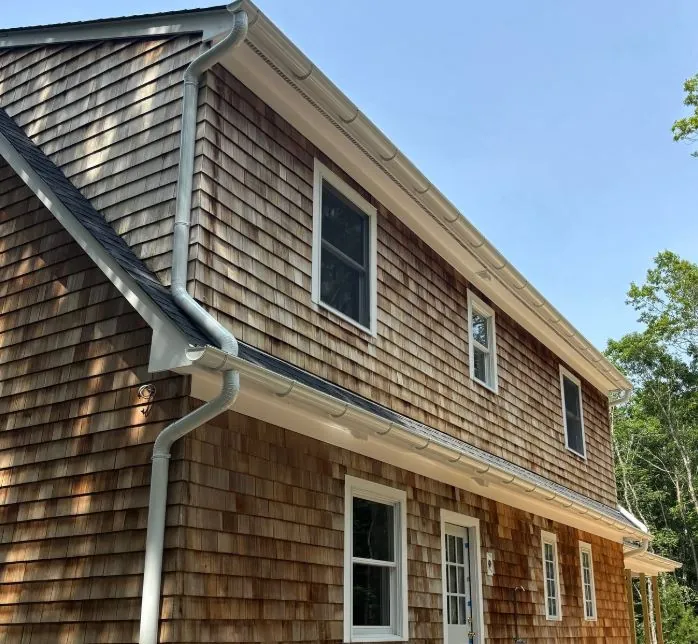
New gutter installation means more than hanging troughs along the roofline. It starts with measuring the roof, picking the right gutter size and profile, and checking the fascia boards that carry the weight. We install seamless aluminum gutters cut on site to fit your home exactly, with hangers spaced to hold during a tropical storm.
Whether you are building a new home, adding an addition, or putting gutters on a house that never had them, we walk you through the choices: K-style or half-round, 5-inch or 6-inch, downspout count and placement, and whether guards make sense for your tree cover. The goal is a system that handles a Jacksonville thunderstorm without overflowing and keeps water off your foundation.
When a new gutter installation makes sense
New construction
The house is just finished and needs a full gutter system before the first rainy season.
Home addition or remodel
A new wing or roofline changes the drainage pattern; the old gutters no longer cover the footprint.
House never had gutters
Some older Jacksonville homes were built without gutters, and water has been falling straight onto the ground next to the slab.
Fascia boards are being replaced
Rotted fascia gets repaired, and that is the right time to hang new gutters instead of reusing old ones.
Persistent foundation issues
Water pools near the slab after every storm; a properly sized and pitched system directs it away.
Switching from sectional to seamless
Old sectional gutters leak at the seams, and the homeowner wants a continuous run with fewer joints.
Gutter options we install
The right choice depends on roof area, overhang depth, tree debris and the look you want.
| Option | Best for | Notes |
|---|---|---|
| 5-inch K-style | Standard single-story homes with moderate roof area | Holds more water than it looks like; works well on most ranch homes when downspouts are spaced correctly. |
| 6-inch K-style | Steep roofs, two-story homes, metal roofs with no overhang | Handles higher water volume and clogs less often with pine straw and oak leaves. See our 6-inch guide for specifics. |
| Half-round | Older homes, historic districts, beach cottages | Smoother interior profile sheds water fast and carries debris out more easily, but needs more hangers and careful pitch. |
| Seamless aluminum | Almost every Jacksonville home | We roll-form seamless gutters on site from flat .027 or .032 aluminum coil. Fewer seams mean fewer leak points over the life of the system. |
How a new gutter installation runs
Measure and inspect
We measure every roofline, check fascia condition, and note where water needs to go. If fascia is soft, we point it out so it can be repaired before we hang gutters.
Size and plan downspouts
We calculate roof area per run and decide between 5-inch and 6-inch gutters, then mark downspouts at the low points where water exits best.
Fabricate on site
We roll-form each run from aluminum coil to the exact length needed. Miters and end caps are cut and fitted, not pieced together from pre-made sections.
Hang and pitch
Gutters are fastened with hidden hangers and pitched toward each outlet. The slope is checked with a level before fastening everything tight.
Test with water
We run water through the system to confirm flow, check for pooling, and make sure downspouts discharge well away from the foundation.
Jacksonville conditions that shape gutter installation
Jacksonville’s summer thunderstorms drop rain in short, intense bursts. A gutter system that is undersized or pitched wrong will overflow at the corners and dump water right next to the slab. That is why we size each run to the actual roof area instead of using one size everywhere. On a typical single-story block home in Arlington or Mandarin, 5-inch K-style usually handles the load when downspouts are placed every 30 to 40 feet. On a two-story home with a steep roof, 6-inch gutters move the extra volume without backing up.
Properties east of the Intracoastal, in Atlantic Beach, Neptune Beach and Jacksonville Beach, deal with salt spray that corrodes exposed steel hangers and fasteners. Aluminum components and stainless hardware are the better choice near the ocean to slow the rust. Inland, the bigger issue is debris: live oaks drop leaves heavily in late winter and spring, and pine straw slides into gutters year-round. Downspout placement and outlet size matter just as much as gutter width when the goal is keeping the system clear. It is also important that splash blocks or downspout extensions carry water well away from the slab, because Jacksonville’s sandy soil drains fast but can wash out if water concentrates in one spot.
What affects the cost of a new gutter system
Every house is different, so we measure and quote each job individually. These are the main factors that change the number.
- Linear feet of gutter
- Total length around the roofline drives material and labor; more feet means more coil, more hangers and more time.
- Gutter size and profile
- 6-inch K-style costs more per foot than 5-inch; half-round costs more than K-style because of the hanger style and installation time.
- Downspout count and height
- 2x3 downspouts are standard for 5-inch gutters; 3x4 downspouts pair with 6-inch. Two-story drops add labor and material.
- Fascia condition
- If fascia boards are rotted, they must be repaired by a carpenter before we can hang gutters. We point it out in the estimate but do not do the carpentry ourselves.
- Debris management
- Adding gutter guards, larger downspouts or extra outlets to handle pine straw and oak leaves changes the total. See our cost guide for a breakdown of what moves the price.
- Access and roof complexity
- Two-story homes, steep pitches and tight lot lines make setup slower and may require more ladder work.
Questions about gutter installation
Do I need 5-inch or 6-inch gutters on my Jacksonville home?
It depends on roof area and pitch. Most single-story ranch homes do fine with 5-inch K-style when downspouts are spaced right. Two-story homes, steep roofs and metal roofs often need 6-inch to handle the volume during a heavy thunderstorm. We measure and recommend the size that matches your roof, not a one-size-fits-all guess.
How long does a new gutter installation take?
A typical single-story home takes one day from setup to cleanup. Larger homes, two-story jobs and complex rooflines can run into a second day. We fabricate the gutters on site, so there is no waiting for pre-cut sections to arrive.
What happens if my fascia boards are rotted?
We check every fascia board during the estimate. If we find rot, we note it so you can have a carpenter replace the bad sections before we arrive. Gutters need solid wood to fasten into; we cannot hang them on soft or crumbling fascia.
Can you install gutters on a metal roof?
Yes. Metal roofs shed water faster than shingle roofs, so we usually recommend 6-inch gutters and pay extra attention to hanger placement. The gutter must be mounted to catch the fast-moving sheet of water that slides off the roof edge.
Do I need gutter guards on a new system?
Not always, but if you have live oaks or pines close to the house, guards reduce how often you will need to clean the gutters. We can install them with the new system or add them later. We are happy to talk through whether they are worth it for your tree situation.