
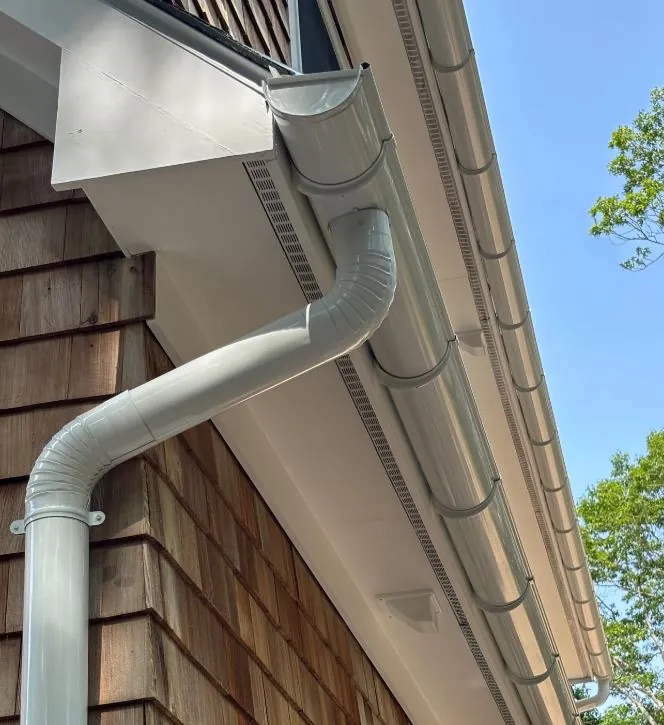
Most gutter problems start at the downspouts. Too few, too small, or pointed at the slab edge, and water pools where it should not. In Jacksonville's summer downpours, a single 2x3 downspout can overflow while rain is still falling.
We replace undersized downspouts, add new ones where roof valleys concentrate runoff, and run extensions or underground lines that carry water well away from the foundation. Every downspout we hang is pitched to drain completely, with no standing water left for mosquitoes.
Why downspout placement matters more than gutter size
A gutter that holds water is a gutter that overflows. The downspouts are the exit. When they are too small or spaced too far apart, the whole system backs up during heavy rain. We calculate how many downspouts a roofline needs based on roof area and local rainfall intensity, not a one-size-fits-all rule.
Placement is just as important. We look for the natural low points on a roofline and put downspouts there. On longer runs we add outlets mid-span so water never has to travel more than 30 to 35 feet before it can drain. This keeps the gutter from pulling away under the weight of standing water.
Where the water goes after it leaves the downspout is the part most homeowners overlook. A splash block on sandy Jacksonville soil can wash out in one season. We run extensions to daylight, bury solid pipe to pop-up emitters in the lawn, or tie into existing drain lines where the grade allows it.
Downspout options we install
The right downspout depends on roof size, overhang depth and where the water needs to go.
| Option | Best for | Notes |
|---|---|---|
| 2x3 rectangular downspouts | Smaller roof sections, sheds, porches | Standard on many homes but easily overwhelmed on long gutter runs or where two roof planes meet. |
| 3x4 rectangular downspouts | Long gutter runs, steep roofs, commercial buildings | Carries roughly twice the volume of a 2x3. We recommend upsizing when replacing old 2x3 systems, especially on homes with large roof footprints. |
| Round downspouts and corrugated adapters | Matching half-round gutters or tying into existing underground drains | Smooth interior walls move water faster than rectangular profiles with the same cross-section. We use them where appearance or existing plumbing dictates the shape. |
| Underground drain lines to daylight or pop-up emitters | Properties where surface extensions would cross walkways or pool decks | Solid PVC or corrugated pipe buried below the frost line and sloped to release water at the curb, a swale or a pop-up emitter in the lawn. |
| Splash blocks and above-ground extensions | Areas with good natural drainage away from the slab | A low-cost option that works when the ground slopes away from the house. We use rigid extensions or formed concrete splash blocks, not flimsy roll-out plastic. |
How a downspout job runs
Walk the roofline
We check every gutter outlet, measure roof sections that feed each downspout, and look for overflow stains on fascia and splash marks on the ground.
Check the grade
We note where the ground slopes toward the slab and where sandy soil has already eroded around existing downspouts.
Size and place
We mark new downspout locations, decide between 2x3 and 3x4, and plan the route from the outlet to the final discharge point.
Install and route
We cut outlets, hang downspouts with wall straps, and run extensions or underground pipe sloped at a minimum quarter-inch per foot.
Test with water
We run a hose at the high end of each gutter section and watch the flow. If water backs up or spills, we adjust before we leave.
Downspout drainage on Jacksonville slab homes
Most Jacksonville homes sit on slab-on-grade foundations. When downspouts empty next to the slab, water seeps under the edge and can cause the slab to heave or crack over time. Sandy soil drains fast, but it also erodes fast. A downspout pouring onto bare sand will dig a crater in weeks.
Properties east of the Intracoastal deal with salt spray that corrodes exposed steel brackets and fasteners. Aluminum downspouts with stainless steel or powder-coated straps are a better choice in those areas. Inland neighborhoods see less salt, but the humidity still rots fascia boards behind leaky downspout connections. We check the fascia at every outlet and flag rot before we hang new downspouts.
Pine straw and live-oak leaves clog downspout elbows quickly. We install downspouts with cleanout access at the first elbow so you can clear a blockage without taking the whole run apart. For homes surrounded by pines, we often recommend larger downspout openings that pass needles more easily.
Downspout problems we fix
- Downspout dumps water at the slab edge
- We add a rigid extension or bury a drain line that carries water at least 6 feet from the foundation, farther if the grade is flat.
- 2x3 downspouts overflow in heavy rain
- We upsize to 3x4 downspouts and add outlets mid-span on long gutter runs so water has a shorter path to drain.
- Splash blocks sink or wash out in sandy soil
- We set splash blocks on a compacted gravel base or switch to an underground line with a pop-up emitter that spreads water evenly.
- Downspout elbows clog with pine straw and oak leaves
- We install cleanout access at the first elbow and, where the roofline allows, use wider downspout openings that pass debris.
- Rusted straps and loose downspouts
- We replace old steel straps with aluminum or stainless straps and add wall anchors where brick or stucco has crumbled around the old fasteners.
- Downspouts buried in landscaping that back up underground
- We dig up collapsed or root-filled drain lines and replace them with solid pipe sloped to daylight or a pop-up emitter.
Questions about downspouts and drainage
How many downspouts does my house need?
It depends on roof area and gutter layout. A rule of thumb is one downspout for every 30 to 40 feet of gutter run, but we also look at roof valleys that concentrate water. A valley can dump more water into one 10-foot section than the rest of the gutter combined, so that spot often needs its own downspout.
Should I upsize from 2x3 to 3x4 downspouts?
If you see water spilling over the gutter during normal rain, or if your current downspouts are 2x3 on long runs, upsizing helps. A 3x4 downspout handles about twice the flow. We also check whether the gutter itself is large enough. A 5-inch K-style gutter with 3x4 downspouts is a common combination for Jacksonville's heavy rain.
Can you run downspouts underground?
Yes. We bury solid pipe sloped away from the house to a pop-up emitter in the lawn or to daylight at a curb or swale. We do not tie into storm sewers or plumbing drains. The pipe runs on top of undisturbed soil and we backfill with gravel and sand so it stays pitched.
What happens if my fascia is rotted behind the downspout?
We point out rotted fascia when we see it during the estimate. The fascia needs to be repaired before we can hang gutters and downspouts securely. We do not do fascia repair ourselves, but we can wait until your carpenter finishes the work and then come back to install.
Do downspouts come in colors?
Yes. We stock white, brown, and a range of other colors to match or complement the gutter and trim. Downspouts are painted aluminum, so the color is baked on and holds up to sun and salt air better than bare metal.