
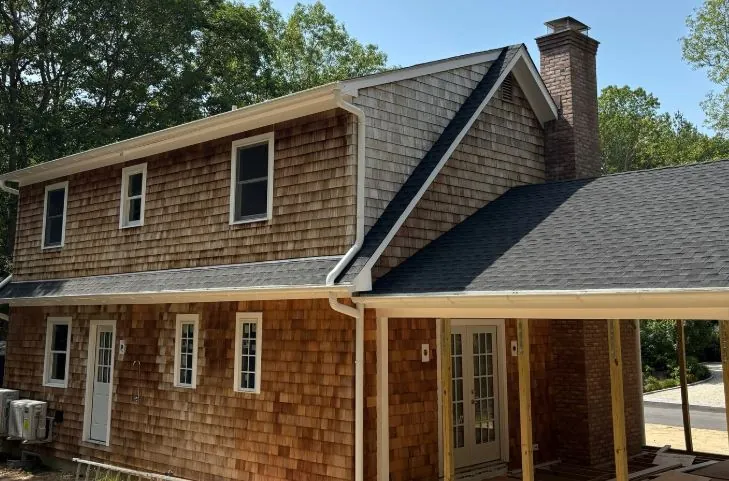
Old gutters do more than look worn. They pull fasteners out of the fascia, dump water against the foundation, and let moisture sit against the eaves. When repairs can’t fix the pitch or the metal is too thin and corroded, replacement is the practical next step.
We handle full and partial tear-off, inspect the fascia boards behind the old gutters, and hang new seamless runs with the right hangers and slope. The result is a system that moves water away from the house instead of letting it pool where it shouldn’t.
Signs replacement makes more sense than repair
Gutters pulling away from the fascia
When hangers have stripped out or the fascia behind them is soft, tightening screws won’t hold. The gutter keeps sagging and water spills over the back edge.
Seams that drip or separate
Sectional gutters joined with sealant eventually split at the seams. Once the metal itself has warped, resealing is temporary and the joints will open again.
Rust bleeding through the paint
Steel gutters in Jacksonville’s humidity rust from the inside out. Pinholes and flaking metal mean the gutter is losing structural strength and will keep leaking.
Overflow during ordinary rain
If a 5-inch gutter can’t keep up with a typical afternoon thunderstorm, the system is undersized. Replacing with 6-inch troughs and larger downspouts solves the capacity problem.
Water stains or rot on the fascia
Dark streaks and peeling paint on the fascia board indicate water has been getting behind the gutter for a while. The board often needs repair before new gutters go up.
Multiple sections patched and still leaking
When you have three or four repaired spots on the same run, the metal is past its useful life. Replacing the whole run costs less over time than chasing leaks season after season.
How a gutter replacement job runs
Tear-off and inspection
We remove the old gutters and downspouts and inspect the fascia board underneath. Any rot or damage gets pointed out so it can be repaired before new gutters are hung.
Fascia repair coordination
We do not replace fascia boards ourselves, but we flag every soft or rotted section in the estimate. A carpenter or handyman can handle the repair, and we return to hang gutters once the wood is sound.
Seamless gutter fabrication
We run .032 aluminum coil through a portable machine on site, cutting each trough to the exact length of the eave. No seams except at corners, which reduces leak points.
Hanging with correct pitch
We fasten the new gutters with hidden hangers screwed into solid wood, set to a slope that moves water toward the outlets without ponding. Downspouts are sized and placed to handle the roof area they drain.
Cleanup and water test
We haul away all old metal and debris, then run water through the system to confirm flow and check for drips at miters and end caps.
Fascia and soffit condition during replacement
When old gutters are pulled off, the fascia board often tells a story. In Jacksonville’s humidity, a board that has been wet for years is often soft to the touch or shows dark rot along the top edge. Hanging new gutters on compromised wood is a waste of money, because the fasteners won’t hold and the board will keep decaying behind the new aluminum. Read our fascia guide for what to look for.
We flag every section of fascia that needs attention and note it in the estimate. If you have a carpenter lined up, we can schedule around the repair. If you need a referral, we can point you toward contractors who handle fascia and soffit work in the Jacksonville area. We hang the new gutters only after the wood is solid and ready to accept screws.
Replacement options we discuss on site
Every house is different, so we walk the property and talk through what makes sense for your roof and budget.
| Option | Best for | Notes |
|---|---|---|
| 5-inch vs 6-inch K-style | 6-inch for steep roofs, wide eaves, or homes that overflowed with 5-inch before | A 6-inch trough carries noticeably more water and pairs with 3x4 downspouts instead of the standard 2x3. |
| Half-round gutters | Older homes, historic districts, or anyone who wants a smooth interior that sheds debris faster | Half-round is less common in Jacksonville but works well with tile or metal roofs and resists corrosion when hung with brass or stainless brackets. |
| Downspout count and placement | Long gutter runs or valleys that concentrate a lot of water in one spot | Adding an extra downspout or moving an outlet can fix overflow problems that the original layout never handled correctly. |
| Splash blocks vs underground drains | Properties where water pools near the slab or washes out landscaping at the discharge point | Splash blocks are simple and inexpensive. Underground drain lines tied to pop-up emitters move water farther from the foundation but require trenching. |
| Partial replacement to match existing | One damaged run where the rest of the system is still sound and the profile and color are available | We can replace a single side or rear run and match the existing aluminum as closely as possible, though older colors may have faded. |
What drives the cost of gutter replacement
Every estimate is based on the house itself, there is no flat per-foot price that fits all jobs. These are the main factors that move the number.
- Linear footage and number of stories
- More feet of gutter means more material and labor; two-story homes add ladder work and safety setup time.
- Fascia repair scope
- If several boards need carpentry work before gutters can be hung, that adds cost handled by a separate contractor.
- Gutter profile and size
- 6-inch K-style costs more than 5-inch, and half-round with external brackets costs more than standard K-style.
- Downspout count and extensions
- Extra downspouts, longer runs, or underground drain connections increase material and trenching labor.
- Disposal of old gutters
- Tear-off and haul-away are included, but very long runs or heavy steel gutters take more time to cut down and load.
- Corner and miter complexity
- Bay windows, bump-outs, and multiple roof angles add inside and outside miters that take time to fabricate and seal.
Questions about gutter replacement
How do I know if I need replacement or just repair?
If the problem is limited to one loose hanger, a separated end cap, or a short section that pulled out of the outlet, repair usually works. When the metal is corroded through, the pitch is lost across a long run, or water damage is spreading behind the gutter, replacement costs less over time than repeated patchwork. We give you an honest read during the estimate.
Can you replace just one side of the gutters?
Yes, if the rest of the system is sound and we can get a profile and color that match reasonably well. Partial replacements are common on rear eaves or garage runs. Keep in mind that older aluminum may have faded, so the new section might look slightly different for a season or two until it weathers in.
What happens if the fascia is rotted when you pull the old gutters?
We stop and show you exactly what we found. We will not hang new gutters on soft wood. The estimate will note which boards need replacement, and we can coordinate timing with a carpenter you hire. Once the fascia is solid, we come back and finish the install.
Do you use seamless gutters for replacements?
Almost always. We run .032 aluminum coil on site and cut each trough to the exact length of the eave. The only seams are at corners and downspout outlets, which eliminates the leak points you get with sectional gutters joined every ten feet.
How long does a full gutter replacement take?
Most single-story homes are done in one day, including tear-off, fabrication, hanging, and cleanup. Two-story homes or jobs with complicated rooflines and many corners may run into a second day. We confirm the timeline when we measure the house.