
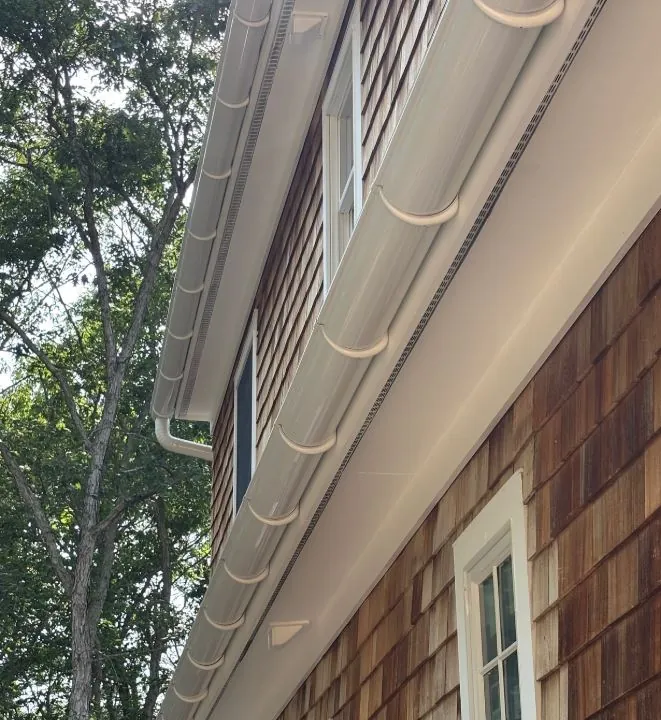
Aluminum is the material recommended for most properties. It does not rust, weighs less than galvanized steel, and handles the sudden downpours of summer thunderstorms without leaking. Each gutter is formed on site and attached with fasteners matched to the property location.
Whether the property is at the beach or in an inland subdivision, the hanger spacing and hardware are adjusted so the system stays tight for decades. K-style aluminum gutters are installed in a range of colors with a baked-enamel finish that resists fading and light scratches.
Why aluminum works in Jacksonville
Aluminum cannot rust. Galvanized steel eventually loses its zinc coating at cut edges and scratches; aluminum simply forms a thin oxide layer that stops further corrosion. In a climate with daily summer rain and constant humidity, that difference matters over ten or fifteen years. Aluminum also weighs about a third of what steel weighs, which puts less strain on fascia boards and eaves.
Baked-enamel factory finishes on aluminum coil stock are cured at high heat. The coating bonds to the metal and does not peel like some liquid-applied paints. Standard white, off-white, and brown are carried, plus other colors on request. Salt air near the coast demands the right hardware, salt air guide explains fastener reactions, and aluminum gutters should be paired with stainless steel screws or aluminum fasteners to avoid galvanic corrosion.
Copper gutters are another material some homeowners ask about: copper develops a patina and costs more, and copper is not fabricated on the truck, but aluminum remains the practical choice for most Jacksonville budgets.
Aluminum gauge and profile choices
Two commonly used aluminum thicknesses and the K-style profile that fits Jacksonville architecture are stocked.
| Option | Best for | Notes |
|---|---|---|
| .027 aluminum | Residential homes with standard rafter spacing and moderate tree cover | Carries typical residential roof loads and costs less. Hanger count is increased where pine straw or oak leaves pool heavily. |
| .032 aluminum | Homes near the beaches, two-story buildings, and commercial low-slope roofs with larger drainage areas | Thicker coil resists dents from falling branches and holds its shape better under heavy rainfall volume. |
| K-style profile | Most Jacksonville homes: ranch houses, newer two-story subdivision homes, condos, and commercial strip centers | Flat back sits flush on fascia; decorative front mimics crown molding. Carries more water per inch than half-round. |
| Half-round profile | Older beach cottages, historic-style bungalows, or anywhere the look matters more than max capacity | Less common. Requires different hanger brackets. It can be ordered when the design calls for it. |
Aluminum gutters in Jacksonville: inland versus coastal
Jacksonville’s climate pushes a lot of water off the roof fast. Afternoon thunderstorms can drop heavy rain in a short time, and a tropical storm can bring wind-driven rain for a full day. Aluminum gutters sized correctly, usually 5-inch K-style for residential, sometimes 6-inch for steep roofs or commercial, move that water away before it pools at the foundation. In sandy soils common around Jacksonville, overspill near the slab can wash out bedding material and cause pavers to settle unevenly.
Coastal properties from Jacksonville Beach down through Atlantic and Neptune Beach see salt spray that inland homes never get. Salt-laden air attacks bare steel screws, zinc brackets, and uncoated hangers much sooner than inland. All-aluminum or stainless-steel fasteners are the better choice at beach jobs, and end caps and miters should be sealed so salt moisture never sits inside the trough. Read our coastal guide for details on material choices near the ocean. Inland, around Mandarin or the Westside, pine needles and oak leaves are the bigger threat, tighter hanger spacing and debris-shedding outlet details reduce clogging at the downspout entry.
How an aluminum gutter installation runs
Inspect fascia and eaves
The roofline is walked and wood fascia is checked for rot. If boards are soft, that is noted in the estimate, the boards must be repaired before gutters go up.
Measure and plan pitch
Run lengths are shot, the high point is found, and a consistent fall is marked toward each downspout outlet. No flat spots.
Form gutters on site
Aluminum coil runs through a portable gutter machine set at the property. Each length is one piece, seamless except at corners, cut to exact feet and inches.
Mount with correct hangers
Hidden hangers or brackets are fastened to the fascia at a spacing that matches the gauge and the debris load the roof produces.
Install downspouts and outlets
Outlet holes are cut, 2x3 or 3x4 downspouts are attached, and splash blocks or extensions are added so water discharges away from the foundation.
What drives the price of aluminum gutters
Every gutter job is measured to the house, so linear feet and site conditions set the price. The main factors are listed here, and one number is given with the estimate.
- Total gutter length
- More roof perimeter equals more coil, more hangers, and more labor, the biggest cost driver.
- Gauge choice
- .032 aluminum costs more per foot than .027; it also takes a little more time to form.
- Number of downspouts
- Long gutter runs may need additional downspout drops, outlets, elbows, and splash blocks.
- Fascia condition
- If fascia boards are rotten, replacing them is a separate repair before the gutters are hung.
- Coastal hardware upgrade
- Stainless fasteners add a small amount per hanger; they stop rust streaks that plain screws develop in salt air.
- Story height and access
- Two-story runs or steep pitches require extra ladder staging and take longer.
Questions about aluminum gutters
Do aluminum gutters rust in Jacksonville?
No. Aluminum does not contain iron, so it cannot form rust. It develops a thin oxide coating that stops corrosion. That makes it a strong choice for Jacksonville’s wet summers and salt-exposed beach neighborhoods.
Which gutter size fits a Jacksonville ranch house?
Most single-story ranch homes do well with 5-inch K-style aluminum gutters and 2x3 downspouts. The roof area and pitch are checked: a steep roof or a large hip roof may need 6-inch gutters and 3x4 downspouts to handle heavy thunderstorm volume.
How long do aluminum gutters last near the ocean?
Aluminum itself holds up well near salt air. The weak points are fasteners and end pieces. With stainless steel or all-aluminum hanger screws and sealed seams, aluminum gutters at Jacksonville Beach typically last 20 years or more with basic upkeep.
Can aluminum gutters handle pine needles without clogging?
Pine needles and oak leaves will get into any open gutter. The runs are pitched to move water toward the outlets, and clean-out-friendly downspout connections are installed. Adding gutter guards later is an option, but a properly pitched aluminum gutter washes most debris toward the downspout during a heavy storm.
What is the difference between seamless aluminum and sectional aluminum gutters?
Seamless aluminum gutters are formed from a single coil on site. There are no splice joints along the run except at inside and outside corners. Sectional gutters come in pre-cut lengths that snap together, and every joint is a future leak point. Seamless means fewer leaks and less maintenance: see our seamless page for how the machine works.