
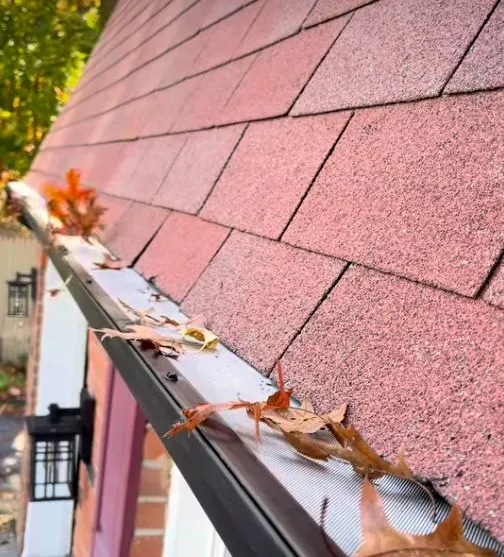
Gutter guards are not a set-it-and-forget-it solution. They reduce the amount of debris that gets into the gutter trough, which means fewer cleanings and less standing water. In Jacksonville, where live oaks and pines drop something almost year-round, a well-chosen guard makes a real difference.
Mr Gutter Installation Jacksonville fits guards to existing gutters or pairs them with new seamless gutters. We focus on hardware that can pass heavy rain without backing up and that does not trap pine needles on top of the gutter.
Types of gutter guards we install
Every guard style has trade-offs, here is how they compare for a Jacksonville home.
| Option | Best for | Notes |
|---|---|---|
| Micro-mesh | Pine needles and fine debris | Stainless mesh with small openings that needles sit on top of. Heavy rain washes them off if the gutter pitch is right and the roof is not flat. |
| Perforated aluminum screens | Oak leaves and larger debris | Punched aluminum panels that snap or screw onto the gutter lip. Needles can wedge in the holes, so they work better away from heavy pine cover. |
| Reverse-curve / surface-tension | Leafy neighborhoods with steep roofs | Solid metal hood that sends water around a curve while leaves slide off. In a cloudburst, some water can overshoot; we check roof pitch before recommending these. |
| Foam and brush inserts | Temporary or low-budget use | Porous foam or bristle strips that sit inside the gutter. Pine needles embed in them, and they hold moisture against the gutter bottom, accelerating corrosion. |
Why Jacksonville gutters need guards built for pine needles and storms
Pine straw is the number-one gutter problem across Northeast Florida. Longleaf and slash pine needles slip past wide openings, pack down tight, and block outlets. A guard with openings larger than a matchstick tip will let needles through. This is common in neighborhoods like Mandarin, where mature pines tower over roofs.
Summer thunderstorms bring short, heavy downpours. If a guard slows water entry, the gutter overflows and soaks the fascia. We size guards to match the roof area and pitch so the gutter still takes the water faster than it arrives.
Properties near the ocean get salt spray that attacks exposed steel fasteners and aluminum screens with steel cores. Stainless or aluminum fasteners are the better choice near the ocean, and it is wise to avoid guards with mixed-metal parts that corrode in salt air.
How a gutter guard installation job runs
Inspect the gutters and fascia
We check for rot, loose hangers, sagging runs, and wrong pitch. Bad gutters get repair before guards go on.
Measure and match the guard type
We pick a guard style based on the trees overhead, roof slope, and gutter size, K-style or half-round, usually 5-inch or 6-inch.
Clean and prep the gutter trough
All debris comes out. We flush the gutter and downspouts to confirm water flows freely before covering anything up.
Install and secure the guards
Guards are fastened to the gutter lip or under the shingle edge per the manufacturer's method. We check that water sheets into the gutter, not over it.
Test with a hose and walk you through it
We run water from the roof and show you how the guard performs. You see where debris will collect and what occasional maintenance looks like.
Common problems with gutter guards in Jacksonville
- Pine needles pile up on top of the guard
- We angle guards so needles slide or blow off. A pine needle guide we wrote explains which guard shapes shed needles best.
- Water overshoots during a downpour
- We adjust the guard position or switch to a model with a wider collection opening so the gutter catches the full flow.
- Guard traps moisture against the fascia board
- We leave a small air gap and make sure the guard does not wick water backward onto the wood.
- Cheap foam inserts rot inside the gutter
- We remove foam and brush inserts and replace them with a rigid guard that does not sit in standing water.
- Downspout still clogs because fine grit got through
- No guard stops everything. We check downspout strainers and outlets yearly; that maintenance does not go away.
- Guard installed on a gutter with bad pitch
- We re-pitch the gutter before adding guards. A guard on a sagging gutter just hides the problem.
Questions about gutter guards
Do gutter guards stop pine needles completely?
No guard stops every needle. Micro-mesh comes closest because the openings are too small for needles to pass through. Needles still sit on top and need to be brushed or blown off occasionally, especially where pine overhang is heavy.
Can guards handle Jacksonville's summer downpours?
Yes, if they are chosen for the roof area and pitch. We match the guard to the rainfall load so water enters the gutter fast enough. On steep roofs, surface-tension guards can struggle; we test with a hose before finalizing the install.
Will I still need gutter cleaning with guards installed?
Yes, but far less often. You will need to clear debris off the top of the guards and check downspout outlets once or twice a year. The inside of the gutter stays much cleaner, which is the main benefit.
Can you put guards on old gutters, or do I need new ones?
We can install guards on most existing gutters that are in good shape. If the gutters are rusted, pulling away from the fascia, or pitched wrong, we recommend new gutter installation first. Guards on failing gutters are wasted money.
Are gutter guards a good idea near the beach?
They can be, but salt air demands stainless fasteners and aluminum guards without steel cores. We avoid products that mix metals. Even with guards, coastal gutters need more frequent checks because salt spray coats everything.